
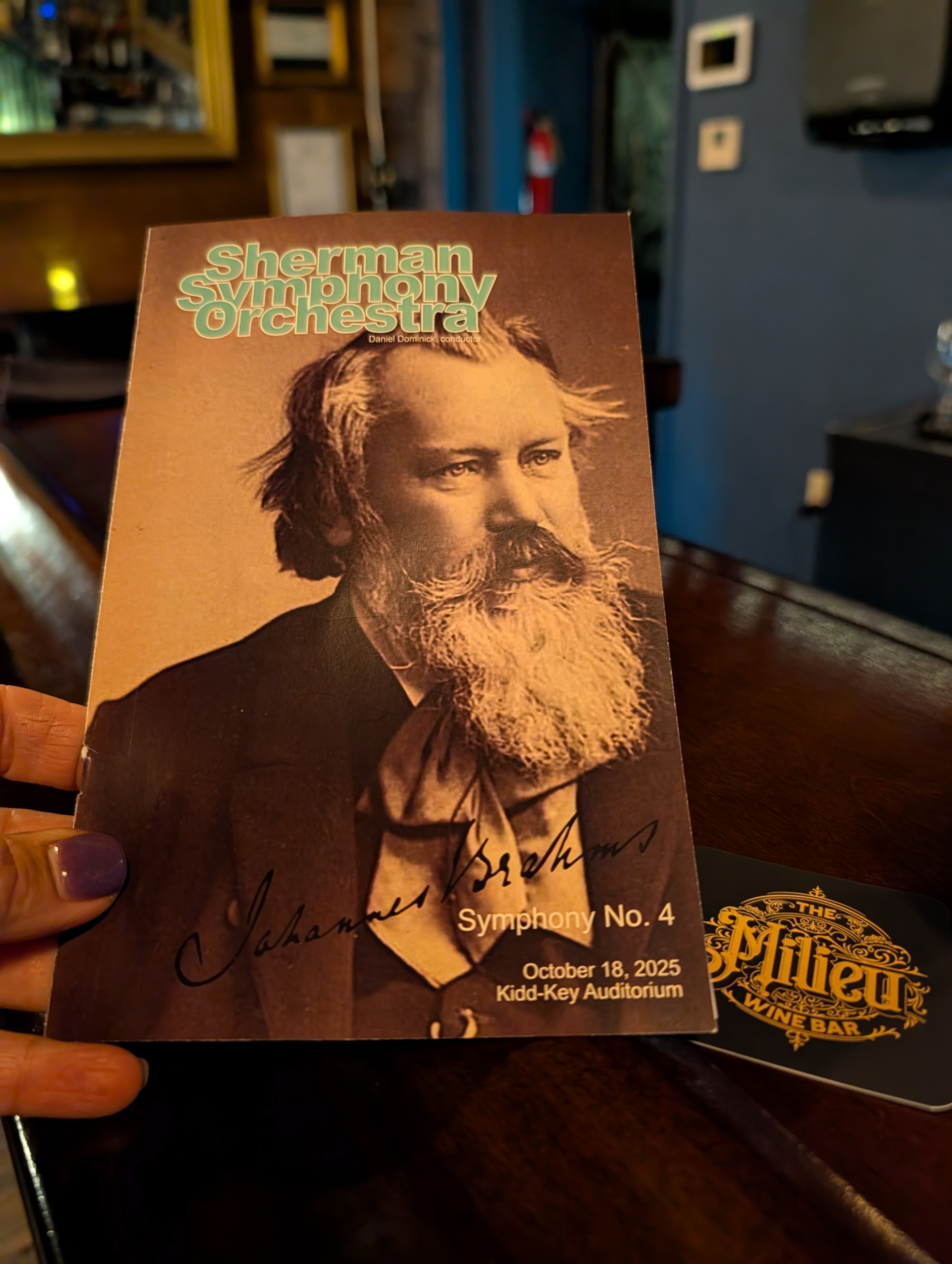
This Saturday, I attended the opening performance of the 60th season of the Sherman Symphony Orchestra (SSO). The performance featured Romantic music of Mendelssohn, Wagner, and Brahms. The concert event page alluded to the composers’ different approaches, noting that Wagner’s ideas “were somewhat extreme and at odds with composers like Brahms.”
That comment lured me into an exploratory session with Claude AI. There is much conversation today about creativity, working styles, and the impact of technology. But the throughline is innovation and how humans balance familiar tools with new ones. (Lest we forget, email wasn’t mainstream 40 years ago, YouTube videos didn’t exist 20 years ago, and Instagram was barely mainstream 10 years ago.) While the concert featured Mendelssohn, Wagner, and Brahms, I invited Gioachino Rossini to the table. Much of my AI collaboration is done in the company of his version of the Stabat Mater. You’ve likely heard the last three minutes of Rossini’s William Tell Overture — or, more casually, “The Lone Ranger Theme” — and hammed up a few “Figaros” from Act 1 of his Barber of Seville opera.
Distinct Profiles
It’s easy to toss every composer into one “classical music” bin. It’s like lumping all dinosaurs together, ignoring that Stegosaurus never saw what T. Rex experienced 80 million years later.
These four composers lived under the Romantic umbrella, but their instincts, aims, and methods couldn’t be more different.
- Rossini (1792–1868) was the pragmatic hedonist who wrote 39 operas in 19 years, then retired from opera at 37 to cook and host dinner parties.
- Mendelssohn (1809–1847) was the polished professional — elegant, multilingual, delivering beautiful work on time, every time.
- Wagner (1813–1883) was the revolutionary who rejected the word “opera” entirely, calling his works “music dramas.”
- Brahms (1833–1897) was a perfectionist who spent 20 years on his first symphony, terrified it wouldn’t measure up to Beethoven.
Four men. Four completely different ways of making something that lasts.
The Constant Amid the Change
Richard Wagner was 20 years older than Johannes Brahms, yet he thought Brahms was stuck in the past. Brahms thought Wagner was destroying the future. Sound familiar? Today there is a lot of crossfire of “AI is an amazing tool” versus “I would never use ChatGPT.” It’s defining work styles and casting shadows on the longevity of some careers. But if you could normalize all the technology, there is a continuous thread of human creativity across eras and vocations. If we could transport ourselves back 150 years, would each of us retain our personal philosophy and be the same poet, salesperson, scientist, or teacher we are today? Indeed, I think our individuality would persist.
Let’s roll the time machine the other way: If these four composers applied their unique work philosophies in the same office today, what would that be like?
I think they would drive each other absolutely insane and make a great sitcom, a la Paramount’s “Ghosts.”
Office Insanity
Gioachino Rossini: The Weaponizer of Procrastination
Rossini’s philosophy was, “Nothing primes inspiration more than necessity.” He often waited until the last possible moment to produce his scores — sometimes literally locked in a room while copyists stood ready. This was pre-1830: Orchestras couldn’t perform a work until copyists hand-wrote every part. At the last minute he’d pour out music with dazzling clarity. He recycled pragmatically (that Barber overture was repurposed from an earlier opera) because he knew what worked on stage.
Rossini didn’t agonize like Brahms or theorize like Wagner; he optimized — for singers, for theaters, for time. (He might have loved AI!) He trusted his first instincts.
If Rossini worked in your office today: He’d look calm all week — while everyone else is panic-refreshing Slack — then ship a brilliant release the night before launch. He’d say, “Let’s not overcook it,” and he’d be right. When asked for a revision, he’d say, “I liked it the way it was,” and somehow, he’d be right. He’d leave at 4:30 every day to “beat traffic.” He’d seem like he wasn’t trying very hard, which would irritate the Brahms types — until you realized his “effortless” work was genuinely excellent. Eventually, he’d take an early retirement package and start a food blog.
“Nothing primes inspiration more than necessity.”
Gioachino Rossini
Felix Mendelssohn: The Polished Professional
Mendelssohn was a translator. He could transform something visual, literary, or emotional into sound that everyone understood. The SSO performed Mendelssohn’s Calm Sea and Prosperous Journey, a concert overture inspired by two Goethe poems. You heard the stillness of becalmed waters. But the cellos belied the serious danger doldrums pose to sailors. Then, with a few wisps of the flute, you know the wind is filling the sails.
He knew his audience. He knew what worked. He delivered it beautifully, every time.
If Mendelssohn worked in your office today: He’d be the creative director everyone loves. His presentations would be gorgeous. His emails would be clear and thoughtful. He’d remember your birthday. He’d have a tasteful Spotify playlist for focused work sessions (which he’d share in Slack without being asked). His projects would come in on time, on brand, and exactly as briefed. You’d never see him sweat.
Richard Wagner: The One Who Burns It All Down
Wagner wanted to reinvent opera. He believed the orchestral music itself could and should tell parts of the story that the chorus and stage settings left unsaid. His operas spanned hours and hours and were expensive to produce. They pushed technology and required new staging approaches. He was, by most accounts, professionally insufferable.
But listening to the Tannhäuser Overture — which tells the story of a medieval knight torn between sacred and profane love — you understand why Wagner couldn’t just write a normal opera. He wanted a revolution to make everything bigger, stranger, more emotionally overwhelming.
If Wagner worked in your office today: He’d be the one proposing that you scrap the entire brand and start over. Every meeting would run two hours over because he’d go off on tangents about “the fundamental philosophy of what we’re trying to achieve here.” He’d write 40-page vision documents that no one asked for. He’d clash with every stakeholder. Half the team would think he was a genius; the other half wants him reassigned. But that one campaign he conceptualized, that everyone said was too risky? It would win awards and completely shift how your industry thinks about marketing.
Johannes Brahms: The One Who Stays Late
The SSO played four movements from Brahms’s Symphony No. 4. It’s one of the late-century exemplars of ‘absolute music.’ Brahms believed music’s sole purpose was to be music (not to reveal plotline as Wagner imagined). The program noted this was his last symphony. Of course it was: Brahms worked so carefully, so slowly, that by the time he finished, tastes were shifting around him.
Listening to it, you can hear why he took so long. Every movement builds on what came before. It’s architectural. Nothing is accidental. The finale is a passacaglia — a variation form built on a repeating bass line — that cycles through 30 variations without ever feeling repetitive.
If Brahms worked in your office today: He’d be the one still at his desk at 8 PM, reorganizing the same PowerPoint for the third time. His projects would always be late, but when they finally landed, they’d be flawless. He’d send 47 versions of the same document with increasingly granular filenames: “Q3_Report_FINAL_v8_ACTUALLY_FINAL_revised.docx.” He’d be brilliant, exhausting, and impossible to rush. His calendar would be blocked for “deep work” three days a week, and he’d actually mean it.
The Meeting That Would Never End
Imagine all four men in the same brainstorming session to create a campaign for a product launch.
- Mendelssohn comes prepared with a thoughtful deck, three concepts, and a proposed timeline. Everything is clear, elegant, and ready to present to the client.
- Brahms hasn’t finished yet. He needs another week. Maybe two. He organized his 17 versions of the tagline into a decision matrix.
- Wagner interrupts to say the entire brief is wrong. We shouldn’t be launching a product; we should be launching a movement. He’s sketched out a multi-year narrative arc that includes a documentary series and an experiential installation. The client didn’t ask for any of this.
- Rossini submitted at 11:59 PM last night. It’s good. It’s actually really good. He’s now looking at his phone.
The meeting dissolves into chaos. Brahms and Wagner start arguing about first principles. Mendelssohn tries to mediate. Rossini orders lunch. Nothing gets decided.
And yet, what if you could somehow harness all four approaches? If you could figure out when to be meticulous and when to trust your gut, when to translate clearly and when to blow everything up? That would be something.

“Nobody Can Beat You at Being You”
The program notes said this concert was about Romanticism, the 19th Century art and music movement. But from Rossini through to Brahms, from 1800 to 1900, technology continued to move along.
- Rossini composed by candlelight with hand-copied manuscripts, in a world where news traveled by mail coach and music existed only in live performance — you might never hear it again locally. No recordings, and revivals weren’t guaranteed.
- Mendelssohn saw the arrival of photography, gas lighting, and railroads, making travel across Europe suddenly feasible.
- Wagner lived through the invention of the telegraph, telephone, and electric lighting, watching news speed from weeks to hours and the world shrink around him.
- Brahms composed under electric lights in his later years, witnessed adoption of the phonograph and the first automobiles, and died in 1897 just as motion pictures were being born.
Each composer was working in a fundamentally different technological reality. Their creative processes were so different that they couldn’t even agree on what music was supposed to be. But all of them created works that are still being performed 150+ years later.
There’s no right way to make something. There’s only your way.
On the drive home from the symphony, I listened to a recent interview with Aneesh Raman, LinkedIn’s Chief Economic Opportunity Officer. He talked about “being the best version of you.” I think individual creativity is a throughline that exists despite eras and technologies. Technology can shape the speed and delivery of your creativity, but it can’t supplant it. AI is a tool. You are you. Be the best version of you — and choose when and how tech supports that.
The Sherman Symphony Orchestra performs at the Kidd-Key Auditorium and Austin College in Sherman, Texas. Their 60th season continues through spring 2026.