
“How Can You Let Them Go?“
My experience of being a bridge in the dog fostering network
Every time someone visits my house or sees a foster puppy on my social media, I hear the same question: “How can you let them go? I would keep them all.”
I understand the impulse. In almost every batch of puppies, there’s one that makes me think, “Oh, I would love to keep this dog.” But if I had kept one from every batch, I’d probably have 18 dogs by now. I currently have six, and that’s down from nine.
Here’s what I tell people: There is so much satisfaction in finding out that a dog ended up with its perfect person that the letting go gets easier. Fostering feels really good when you understand that you are a bridge between a bad point A and a good point B. The goodbye isn’t the sad part of the story. The goodbye is the whole point.
It started with a cat
My husband, Jeff, and I got pulled into the fostering orbit back when we lived in a small condominium in a Southern California suburb, with a little poodle we’d rescued from an intersection and four cats. When a coyote took my sweet black kitty, we went to the county animal shelter to rescue a new cat.
Jeff had never been inside an animal shelter before, and he wanted to walk through the dog aisle. I warned him: “Don’t do it, because if you look one in the eye, then we have to take it.”
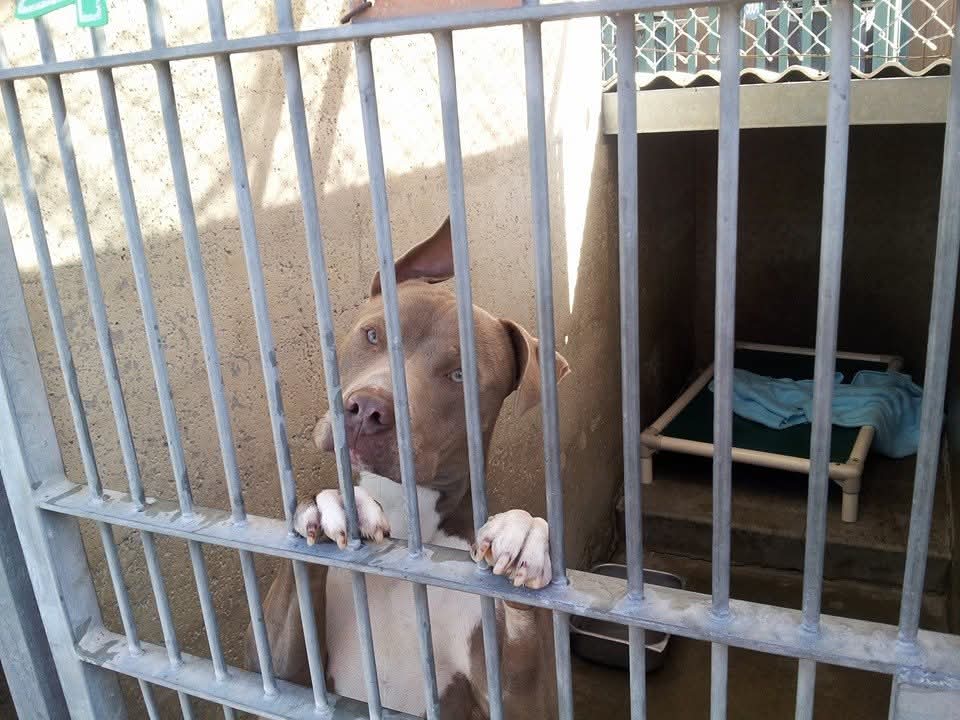
The way Jeff tells it, he walked past kennel after kennel of frantic, barking dogs. Then he came to one that looked dark and empty, except he could tell something was in there. A big pit bull mix stood up, walked calmly to the gate, rose onto his hind legs, put his paws on the bars, and looked Jeff in the eye. Jeff stepped back. The dog, with a kind of resignation, stepped back too. Jeff stepped forward again — and the dog got right back up and met his eyes.

Jeff told him, “Hang on, buddy, I have to go talk to someone.”
A week later, Hank was our dog.
From one dog to a hundred
We had no idea what to do with Hank. He was young, strong, untrained, and full of energy, and walking him through a suburban condo parking lot was unnerving for us and the neighbors. We didn’t want to be the people who said, “It’s a pit bull, it must be bad.” We just genuinely didn’t know what to do with the dog we’d brought home.
So we asked a friend in dog rescue for help. She recommended a trainer, and she offered a safety net: If we couldn’t keep Hank, she could get him into the foster system and help us find a different dog. The training worked out amazingly. Hank became that incredible dog everybody loved.
That was the beginning of our foster journey. Once Jeff learned what shelters and fosters actually do, he volunteered to foster a dog at that little condo. That foster, Dobie, and Hank played like crazy until Dobie was adopted. Then came Howard, a 14-year-old pit bull who just needed a place to live out the last few months of his life. Howard was a spectacular dog, and I miss him dearly. He and Hank played for hours, even though Hank was 2 1/2 and Howard was 14.

Eventually we admitted we had outgrown the condominium and moved to a house with more space. That was over a decade ago. Since then, between two states, we’ve fostered dogs of every description — from massive St. Bernards to mama dogs nursing tiny puppies. Counting the litters (somehow puppies seem to come in batches of 10), we’re probably a hundred dogs in.
The matches and the “foster fails”
The best part is watching the bridge hold. Two of my favorite matches happened simply because friends saw our foster posts. Koaleen fell in love with a puppy named Emma, and the two of them are inseparable now — two peas in a pod, somehow soulmates. Mikkel saw Kara, a gentle pit bull who had come from a bad situation, and wanted a companion for his Labrador. Kara has since passed on, but Mikkel went on to adopt another pit bull. He is passionately in love with the breed now.
Of course, we’ve had our “foster fails” — the term for when you adopt your own foster dog. Hank fell in love with our foster, Audrey. She’d had a rough start and was reassured by Hank’s calm companionship. They played for hours and cozied together; we couldn’t stand the idea of separating them. They made a fantastic pair! Tito, now a big black Lab mix, started as a gangly puppy with long ears and the sweetest big, brown eyes. Despite that sweet face, I worried he’d fall victim to what shelter folks call the “black dog phenomenon” — the belief that big black dogs wait longest for adoption. Whether or not the research bears that out, I wasn’t taking the chance. He’s now a sweet, floppy member of our family as well as an attentive guard dog.
Fixing my corner of the world
People sometimes assume fosters are lone heroes. We’re not. I never agree to take in dogs that people find on their own, because without support, that dog could get stuck with me forever. I don’t personally have a low-cost vet network or a transportation system. What makes fostering work is plugging into an established rescue — for me, that’s the Denison Animal Welfare Group (DAWG) here in Northeast Texas, and before that, I.C.A.R.E. dog rescue in California. These organizations already have the ecosystem: volunteers, vets, transporters, fosters, and sponsors.
That infrastructure moves mountains. My latest batch of puppies got all three rounds of vaccinations through DAWG’s vet, passed their health checks, and recently left on a transport to a shelter in Missouri. Many city shelters simply aren’t set up to do this kind of fostering and transport work.
But all of that coordination takes a team of volunteers, and there’s never enough space, money, or time. All of it — patiently rescuing scared dogs from empty lots, fundraising, cleaning messy kennels, staffing adoption events — it’s all a constant effort by the folks on the front lines of animal rescue. That’s really why I foster: I want to remove a little pressure and fix something in my corner of the world.

The goodbye is the proof
Recently I helped a local gentleman whose dog got out and had 10 puppies (ten! always ten!). I got them into our rescue network, and they went to a rescue in Missouri. A little while later, that rescue sent back photos of the puppies with their new owners — big smiles from families and individuals holding the new puppies they were going to share a life with.
That’s the payoff. You never know how the story is going to end. You just know that you played a part in adding happiness into the world.

If you’d like to play a part, too, you don’t have to foster. Established rescues like DAWG run on donated time and money, and both are just as much a part of the bridge. And if you do think you could open your home to a dog who’s between a bad point A and a good point B — I promise the goodbye is worth it.
About this article: it started as a slide deck
This post began as a Toastmasters presentation — 17 slides, mostly photos, with a title and three big ideas. I wanted to convert the presentation into an article, and I wanted AI to quickly pull it together and type up a solid first draft. (I call the output “a very good first draft” because all drafts need review and editing.) I also wanted to make sure AI included my specifics, not generic assumptions.
Using my Knowledge Capture Session service, I had my AI assistant, Claude, follow an interview prompt. I uploaded the presentation and spent about 20 minutes answering the AI’s questions. The discussion surfaced additional details like Hank’s double-take at the kennel gate, Howard’s last good months, and the photos that came back from Missouri. Once the interview was complete, Claude spent his usual five seconds typing up the first draft.
Since AI can be “pathologically agreeable,” part of my process includes a step that makes AI critique both its own work and my ideas. This step flagged an unverifiable statistic I would have published, as well as some content that sounded good in my head but was harsh on paper.
If you’ve ever given a presentation, led a training, or explained your work to a roomful of people, you’re already sitting on informative articles. The knowledge exists — it just hasn’t been captured yet. Contact me to see how my low-friction process can help!